
Shock Analysis
Ensure your products survive the severe transient loading events encountered throughout their operational life using our specialist Shock Analysis capabilities.
Unlike continuous vibration, shock events are characterised by high-magnitude loads acting over very short durations. These transient events generate complex structural responses that can produce localised stress concentrations, permanent deformation, equipment malfunction or premature fatigue failure if not properly understood during the design stage.
Our finite element analysis expertise enables us to simulate these dynamic events, allowing customers to assess structural integrity, validate designs and minimise development risk before physical testing.
For railway and defence applications, shock loading is typically defined using recognised industry standards such as EN 61373 and DEF STAN 00-35. Although, many UK defence programmes define shock requirements in project-specific specifications. For space applications they are specified for mission-specific launch environments. These standards represent the severe impacts experienced during service, including:
- Coupling and shunting impacts.
- Severe rail defects.
- Off-road terrain and obstacle impacts.
- Weapon firing and battlefield environments.
- Transportation, handling and accidental impact events.
- Ballistic Impacts.
- Rocket launches
Using transient dynamic finite element analysis, we accurately predict structural response to these demanding load cases. The resulting stresses, accelerations and displacements allow us to:
- Demonstrate compliance with customer and industry shock requirements.
- Verify structural strength under high transient loads.
- Identify critical stress concentrations and potential failure locations.
- Assess equipment survivability and mounting integrity.
- Optimise designs to reduce weight while maintaining robustness.
- Reduce costly physical design iterations and qualification testing.
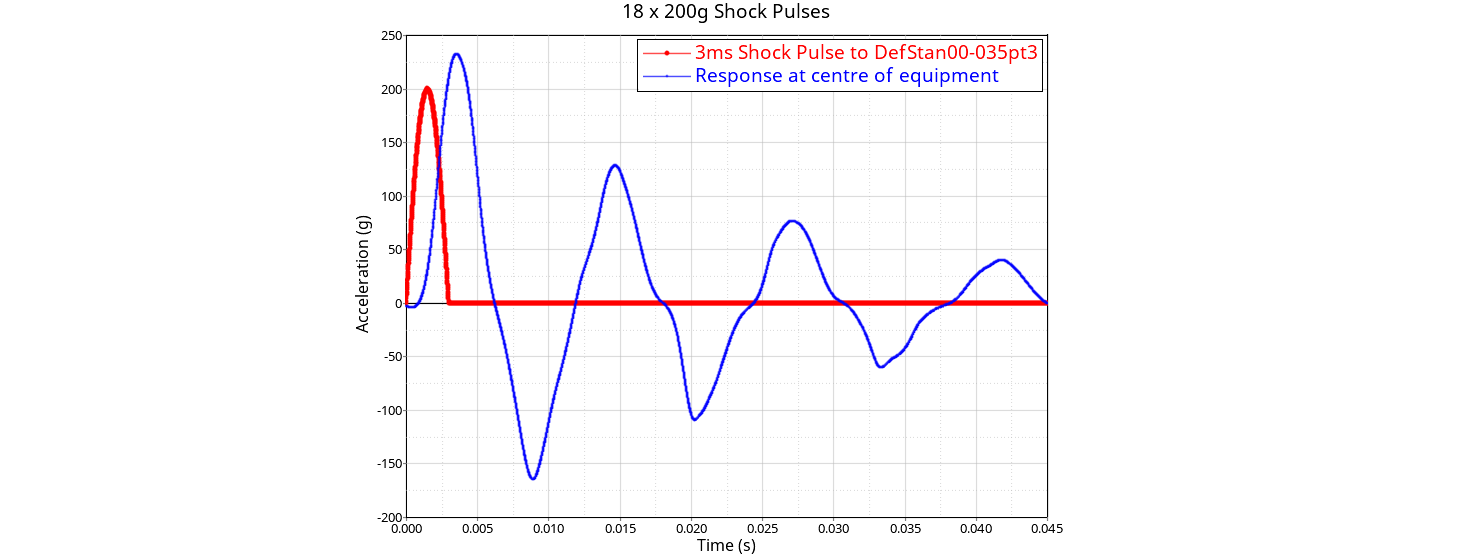
The figure below illustrates typical half-sine shock pulse envelope specified for a defence project together with the response of the equipment being simulated. Although the duration of these events is measured in milliseconds, they can generate structural responses significantly greater than those experienced during normal operating vibration. Note that the response of the equipment at the measurement point amplifies the magnitude of the shock before rapidly decaying. In this case the response for this was the cantilevered nature of the equipment mounting, however, it serves to show the non-linear nature of the shock event.
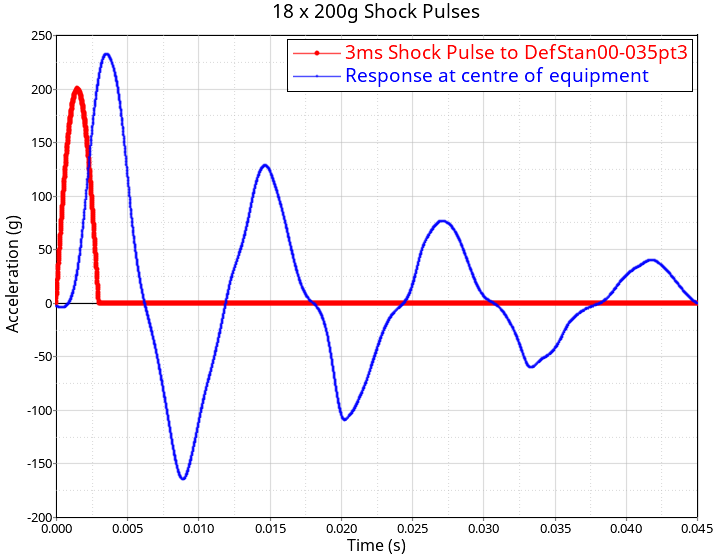
DefStan00-035 part 3 200g 3ms half-sine pulse complete with structural response of the tested equipment.
Whether supporting qualification testing or developing complete digital simulation programmes, our engineers provide detailed insight into structural behaviour during the most demanding transient events, giving confidence that your products will survive both expected operational loads and extreme accidental conditions.
Why customers choose Design & Analysis
Our engineers combine advanced finite element modelling with decades of practical experience in dynamic structural assessment across a wide variety of industry sectors. We understand not only how to perform transient analyses, but also how to interpret the results, correlate them with physical testing and develop practical design improvements that enhance reliability without unnecessary weight or cost.
Note: Shock and vibration are complementary analyses rather than alternatives.
Random vibration predicts fatigue damage accumulated over millions of load cycles during normal operation, whereas shock analysis assesses structural survival under infrequent, high-energy transient events. Most qualification programmes require both analyses to demonstrate complete structural integrity.
See Random Frequency Vibration Analysis Page