
Random Vibration Analysis
Maximise structural reliability under complex, real-world loading conditions using our expertise in Random Vibration Analysis.
Vehicles and equipment of all types—from railway vehicles and defence platforms to launch vehicles and spacecraft—rarely experience simple, single-frequency excitation. Instead, structures are subjected to complex, non-deterministic loading arising from sources such as turbulent airflow, wheel-rail interaction, track irregularities, rough terrain, and rocket engines.
Our advanced frequency-domain finite element analysis capabilities enable us to predict, evaluate and optimise structural response to these highly variable operating environments long before manufacturing starts and physical testing begins.
To accurately represent these loading conditions, we perform Random Frequency Response Analysis (RFRA) using Power Spectral Density (PSD) input profiles defined by recognised industry standards or mission-specific launch environments. These analyses are routinely applied across the rail, defence and space sectors.
From the RFRA results, we calculate Root Mean Square (RMS) stresses and responses, allowing us to:
- Predict structural fatigue life.
- Identify critical resonance conditions.
- Assess peak displacement and acceleration levels.
- Detect potential failure locations before prototype manufacture.
- Demonstrate compliance with customer and industry vibration requirements.
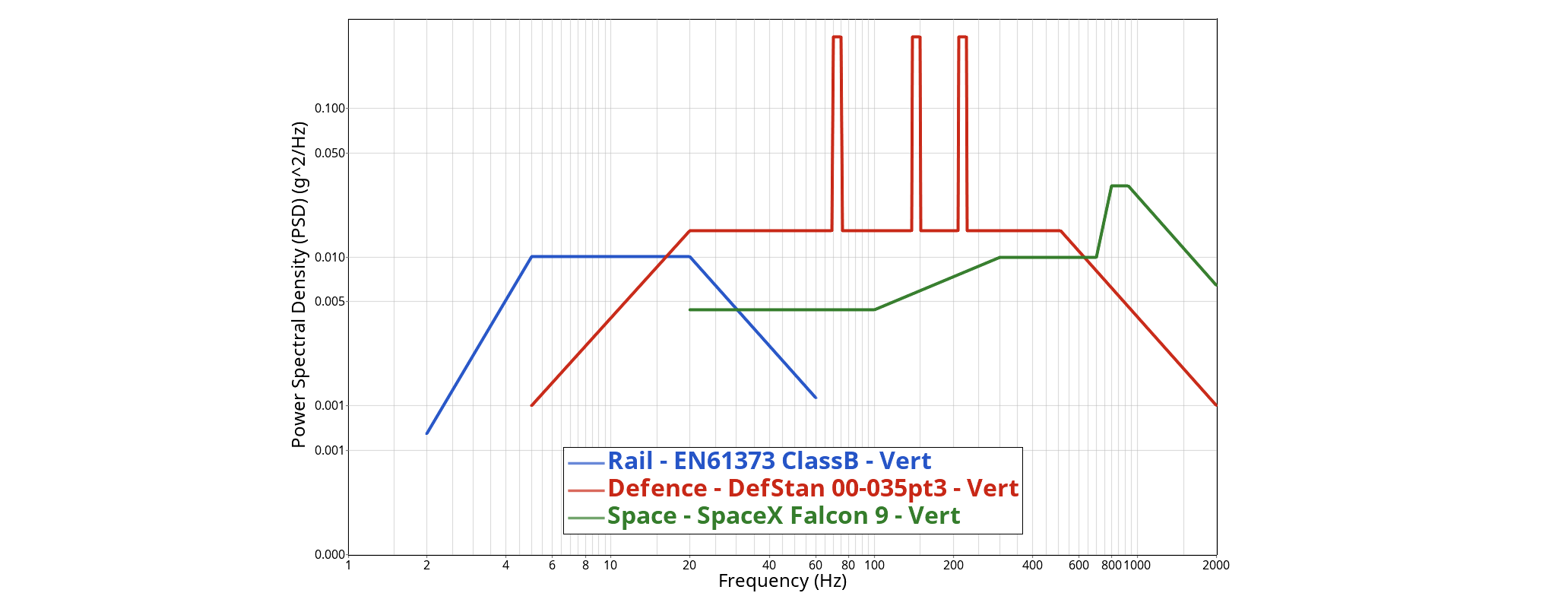
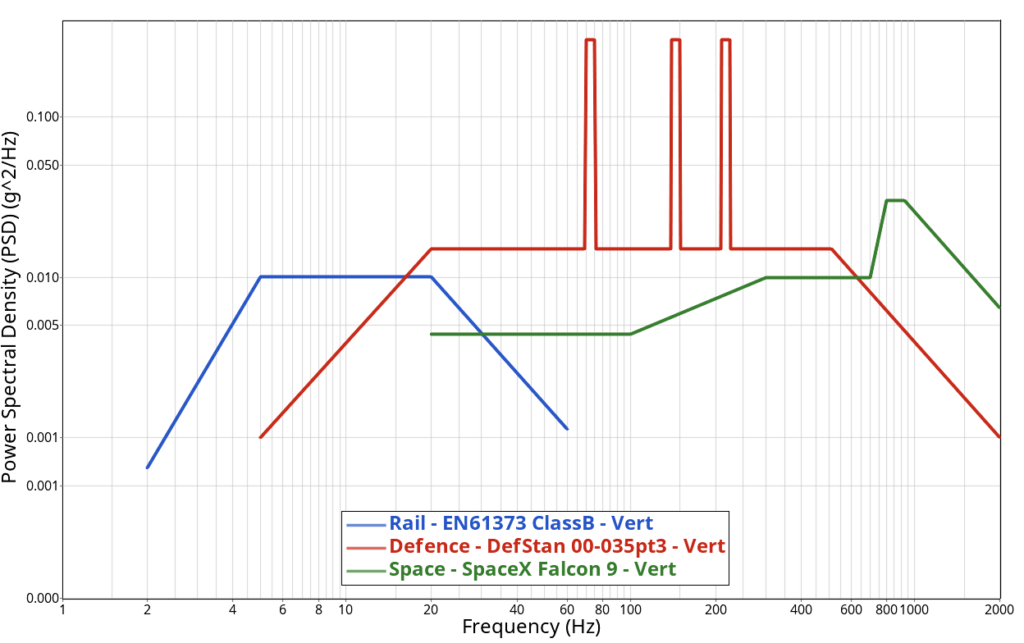
The figure below compares typical PSD input profiles used across three industries: rail, defence and space.
Notable features include:
- Defence vehicles – The vertical spikes represent superimposed swept narrowband excitation used to simulate track-induced vibration (“track patter”) over the frequency range of approximately 70–510 Hz. This loading is particularly challenging for finite element fatigue analysis because cumulative damage must be calculated from multiple discretised PSD spectra.
- Space launch vehicles – The launch vibration environment starts at a higher frequency. Lower-frequency structural loading is generally addressed separately using sine vibration testing and shock analyses.
Whether supporting physical shaker testing or developing fully validated simulation models, we provide the specialist structural analysis expertise needed to ensure products survive some of the world’s most demanding vibration environments.
Why customers choose Design & Analysis
Our engineers combine advanced finite element modelling with decades of practical experience in dynamic structural assessment across a wide variety of industry sectors. We understand not only how to perform transient analyses, but also how to interpret the results, correlate them with physical testing and develop practical design improvements that enhance reliability without unnecessary weight or cost.
Note: Shock and vibration are complementary analyses rather than alternatives.
Random vibration predicts fatigue damage accumulated over millions of load cycles during normal operation, whereas shock analysis assesses structural survival under infrequent, high-energy transient events. Most qualification programmes require both analyses to demonstrate complete structural integrity.
See Shock Analysis Page